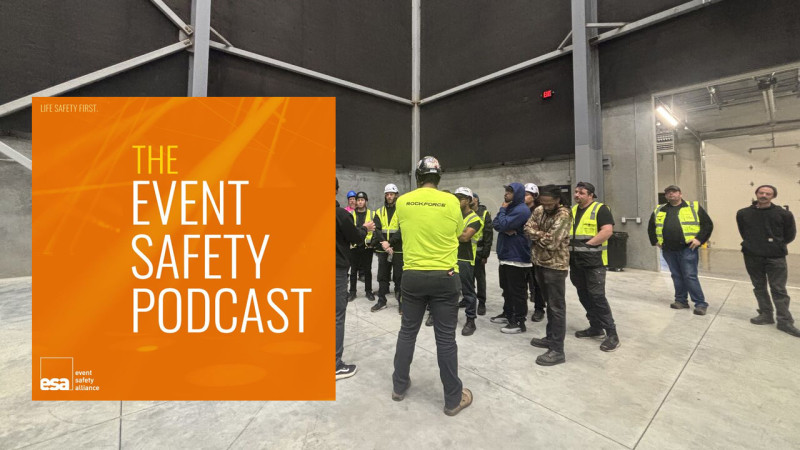
The training program that holds up under live-event conditions is almost never the one in the binder. It is the program running in the room — audited in real time, openly criticized by the people inside it, and reshaped by the load-out the team just walked off of. That is the case Phil van Hest, RockForce's Senior Director of National Safety, builds across Episode 115 of the Event Safety Podcast. In an hour with host Danielle Hernandez, co-host Brian Honeycutt, and RockForce's Sean Fox, Van Hest lays out the architecture of a real Fall Protection program, the discipline of training records at scale, and the harder, less technical work that ultimately determines whether any of it survives contact with a job site: building a culture in which the strongest thing a new crew member can say is "I don't know."
Key Operational Takeaways
Training Is a Living Document, Not a Binder on a Shelf
Van Hest's working methodology is PDCA — plan, do, check, act. A training program has to evolve with the room, which is why feedback loops are built into every RockForce delivery; the classroom has to be a place where it is safe to criticize the instructor and the material, or the program goes stale. The same discipline applies to incident investigation. The smashed finger is a lagging indicator. What matters is what put the finger there — fatigue, inexperience, peer pressure, shame — and that is where the work has to happen. The framing Van Hest brings to the role: safety is a practice, and everyone in it is practicing.
Train in the Room You're Going to Work In
OSHA standards were not written with live events in mind. RockForce's safety curriculum is engineered for the specific hazards of this industry and, wherever possible, delivered inside the venues where crews will actually be working — counterweight grids, loading galleries, festival sites, arena floors. That is an operational distinction, not a marketing one. In one recent national push, the RockForce safety team issued more than 600 certifications across Fall Protection, Forklifts, Reach Forks, and MEWPs A & B on a multi-city delivery tour spanning Las Vegas, Texas, Nashville, Detroit, New Jersey, Philadelphia, Florida, and Los Angeles. The team also maintains a library of in-house RockForce training videos that walk new hires through the fundamentals beginning at the truck and PPE — built for crews who may have three days to wrap an orientation before their first call.
Lead-to-Crew Ratio Is a Safety Metric
A lead managing twenty-two people is not training anyone; that lead is chasing hard hats. Get the ratio down to eight, Van Hest and Fox argue, and the lead has room to actually show somebody how to tie a clove hitch — to coach in the moment. To support large calls and festivals, where crew churn drives a disproportionate share of industry incidents, RockForce deploys safety officers as floaters: untied to a single department, free to move where the help is needed and deliver micro-training in real time. The team has also invested in Mental Health First Aid certification for its safety officers, because leading a live-event crew increasingly demands soft skills alongside the technical ones.
Empower Leads to Be the Stone in the River
A lead, Van Hest argues, is a conduit for information — not a negotiator. Meal-break policy, overtime rules, state and federal law: these have to be known cold, so when a client pushes for a 2 a.m. workaround, the answer is calm, factual, and final. Fox's heuristic for the leads RockForce trains is the one to put on the wall: know the building, know the contract. Between those two, a lead can answer the substantial majority of what production will ask in a load-out.
"Yes, You Are."
The throughline of the conversation is psychological safety. Van Hest recounts overhearing a crew member yell on a job site, "I'm not safety." His response is the line that frames the whole episode:
"Yes, you are, friend. Yes, you are. We all are. We're all there to look out for each other."
That is the culture RockForce is training toward, and the work — Van Hest is clear — is to make it portable across a rotating workforce of up to 32,000 crew, coast to coast.